Humans are Pavlovian dogs. If you ring a bell every time you feed a dog, eventually the dog salivates just at the sound of the bell. You can do this for sleep.
Most people try to buy sleep. We spend billions on weighted blankets, magnesium supplements, silk eye masks, and lavender sprays. While these tools can help, they miss the fundamental biology of rest.
You need a "Sleep Bell"—a specific, repeatable set of actions that you perform only before sleep. Over time, your brain recognizes the pattern and releases melatonin automatically.
This is called Conditioned Insomnia (when your bed triggers stress) vs. Conditioned Sleepiness (when your routine triggers rest).
In this guide, we will build a scientifically robust bedtime ritual that costs exactly $0.
The Science: Circadian Rhythms and "The Drop"
To understand why rituals work, you need to understand the two systems that control sleep:
- Sleep Pressure (Adenosine): The chemical that builds up in your brain the longer you are awake.
- The Circadian Clock: The internal timer that tells your body when to release cortisol (wake up) and melatonin (sleep).
Modern life destroys these signals. Bright lights at night suppress melatonin. Stress keeps cortisol high.
A successful ritual does three physiological things:
- Lowers Core Body Temperature.
- Reduces Blue Light Exposure.
- Signals Safety to the Amygdala.
Phase 1: The Kitchen Close-Down (60 Minutes Before Bed)
The Goal: Separating "Doing" from "Being."
One of the biggest blockers to sleep is the "Open Loop"—the nagging feeling that you forgot to do something. This phase is strict functionality.
- The Final Sweep: Go to the kitchen. Wipe down the counter. Start the dishwasher.
- The Water: Pour a glass of water for your nightstand.
- The Light Switch: This is the most important step. As you leave the kitchen/living area, turn off the main overhead lights. Switch to lamps or hallway lights only.
- Why: Overhead lighting mimics the sun at noon. Low lighting mimics the sunset, signaling melatonin production.
- The Declaration: Say out loud (or think), "The shop is closed." Work is over. Productivity is illegal for the next 8 hours.
Phase 2: The Thermal Drop (30 Minutes Before Bed)
The Goal: Triggering the sleep onset mechanism.
Your body needs to drop its core temperature by about 2-3 degrees Fahrenheit to initiate sleep. This is why it is so hard to sleep in a hot room.
- The Bedroom Prep: Go to the bedroom. Open a window (if cool) or turn on a fan.
- The Quick Wash: Wash your face with cold water. Brush your teeth.
- The Pajama Change: Change into loose, cool clothing.
- Strict Rule: Once the pajamas are on, you are not allowed to check email, open a laptop, or do chores. Pajamas are a uniform. When you wear a uniform, you have a job. Your job now is to rest.

Phase 3: The "Low-Fi" Intake (In Bed)
The Goal: Slowing brain waves from Beta (alert) to Alpha (relaxed) to Theta (drowsy).
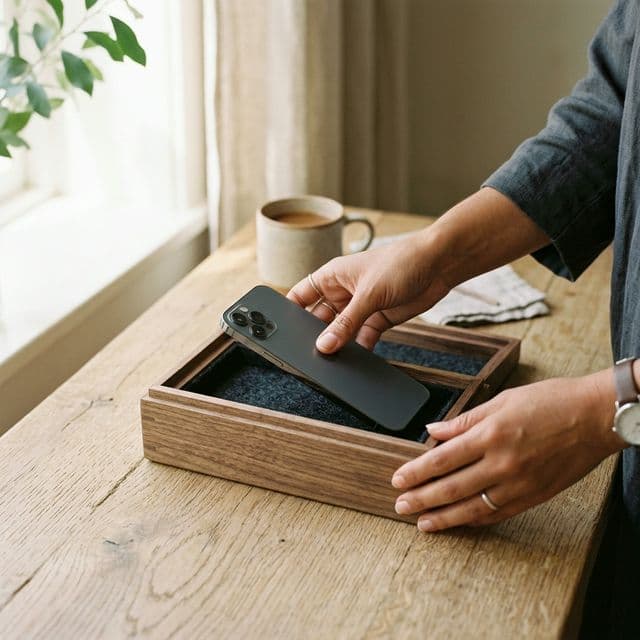
Get into bed. Do not pick up your phone. The phone is a dopamine slot machine. It creates "seeking" behavior, which is the opposite of "resting" behavior.
Instead, choose one of these "Low-Fi" (Low Fidelity) inputs:
Option A: Fiction Reading (The Escapist)
Read a physical book or an e-reader (with warm light).
- Why Fiction? Non-fiction (self-help, business) activates the "Planning/Problem Solving" part of your brain. Fiction activates the "Imagination/Simulation" part, which is much closer to the dream state.
Option B: The "Body Scan" (The Somatic)
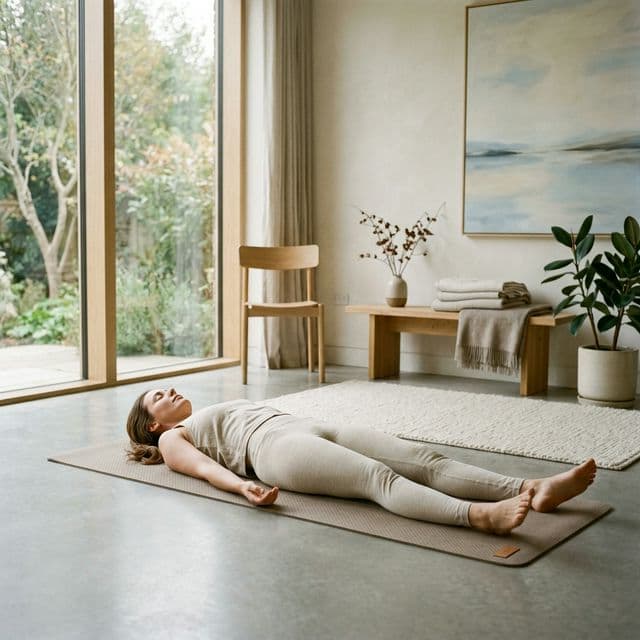
If you are too tired to read, lie on your back and perform a mental scan.
- Feel your toes. Are they tense? Release them.
- Feel your knees.
- Feel your hips sinking into the mattress.
- (Full Guide: Body Scan Meditation Script)
Option C: The "Gratitude Rambling" (The Positive)
Quietly talk with your partner (or think to yourself) about 3 small, boring things that went well today. "The coffee was good." "I saw a nice dog."
- Why: Positive recall shifts the nervous system out of "threat detection" mode.
What Destroys the Ritual?
The ritual is fragile. Here are the three killers:
1. The "Just One Check"
Checking your email "just for a minute" after putting on pajamas breaks the Pavlovian conditioning. It tells your brain: "Pajamas mean work." You must be ruthless about the boundary.
2. Alcohol "Nightcaps"
Alcohol is a sedative, not a sleep aid. It knocks you out, but it fragments your REM sleep and causes wakefulness in the second half of the night (the "rebound effect"). A calm herbal tea or water is infinitely better.
3. Inconsistency
Doing the ritual at 10 PM one night and 2 AM the next confuses your circadian clock. Try to start the "Kitchen Close-Down" at roughly the same time every night.
Frequently Asked Questions (FAQ)
Can I watch TV instead of reading?
Ideally, no. TV emits blue light and is often designed to keep you hooked (cliffhangers). However, if you must watch TV, watch something boring or familiar (reruns of a show you've seen 100 times). Avoid the news or high-stakes dramas.
What if I can't sleep after 20 minutes?
Get up. Lying in bed awake creates "Conditioned Insomnia" (associating the bed with frustration). Go to a different room, keep the lights dim, and read until you feel sleepy again. Then try the bed again.
Should I take Melatonin supplements?
(Disclaimer: Not medical advice). Your body produces melatonin naturally. If you use dim lighting and a consistent schedule, your own production should be sufficient. External supplements can sometimes downregulate your own natural production if used daily for long periods. Try the "Light Diet" first.
Conclusion: The Luxury of Discipline
The most luxurious sleep routine isn't bought at Sephora. It isn't found in a pill bottle. It is built through the discipline of repetition.
Your body wants to sleep. It knows how to do it. You just have to stop interrupting the process and simply ring the bell.
Try This Tonight: Start closely monitoring the light in your home. At 8:00 PM (or 1 hour before bed), turn off the "Big Light." See how your eyes feel 20 minutes later.
Next Read:
- Digital Detox Strategies for Better Sleep
- Best Sleep Positions for Relaxation
- Morning Routine Ideas That Cost Nothing
Budget Wellness Editorial
Wellness Researcher
Specializing in zero-cost mental wellness strategies and breathing techniques.
Join Our Wellness Community
Get one daily, zero-cost wellness habit delivered straight to your Telegram. No noise, just peace.
Join Telegram Community